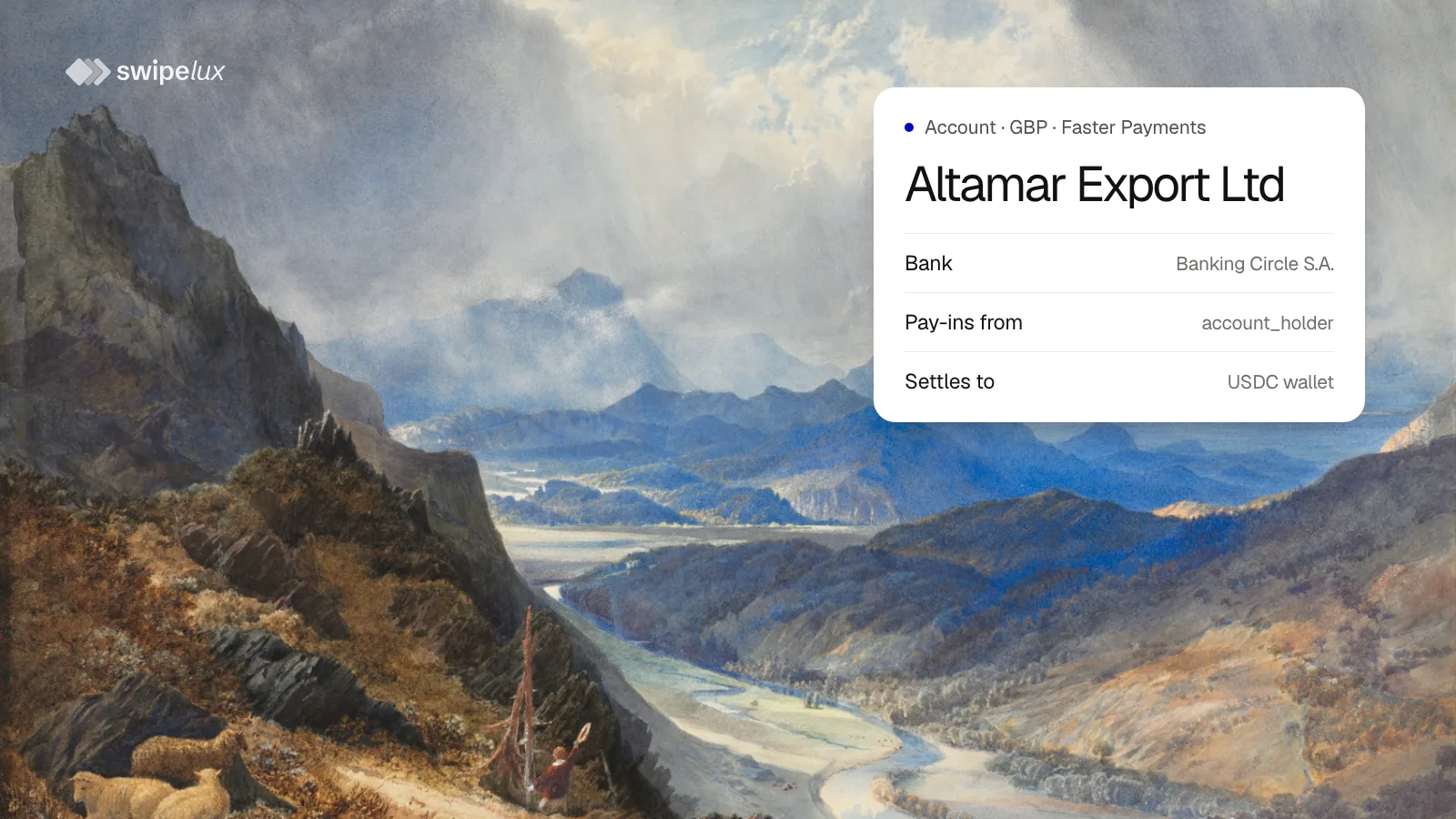
With Swipelux, your clients, business or individual, can get a GBP account in their own name with a UK sort code and account number at Banking Circle S.A., once the Bank accepts them. Each Faster Payments deposit settles to the client's wallet as USDC. The account takes payments only from a bank account in the client's own name; a payment from anyone else is held for review. So it is for clients funding their own wallet, not for collecting from their customers.
What is a GBP named account with a sort code?
A GBP named account is a UK bank account in the client's own name, reachable by a 6-digit sort code and an 8-digit account number. In Swipelux it is the faster_payments_named capability. A sort code identifies the bank and branch, and the pair is what a UK payer types into a banking app to send a domestic payment.
The rail behind it is Faster Payments, which Pay.UK runs day and night, 365 days a year. Pay.UK reports 5.55 billion Faster Payments worth £4.84 trillion in 2025.
Which bank holds the GBP accounts?
Banking Circle S.A. holds Swipelux's GBP named accounts. Its regulatory information page says Banking Circle S.A. is authorised as a credit institution in Luxembourg and has a UK branch in London, whose regulators are the Prudential Regulation Authority and the Financial Conduct Authority.
Read the bank from the API instead of hard-coding it. The supported-capability response lists each bank for a capability with its name, and the account read returns the bank as institution with id and name. The capabilities guide explains how to read it.
Can anyone pay into it, or only the client?
Only the client. The GBP named account accepts pay-ins only from a bank account in the client's own name, which is a first-party payment. The bank's entry under banks in the supported-capability response says so with payin.senders: "account_holder"; a bank with no known restriction shows "anyone".
That fits a client moving its own pounds: a business moving money from its own UK account, or an individual funding their wallet. It does not fit a client that wants its UK customers to pay it directly. For that, compare the options in first-party vs third-party payments.
| Sender | What happens | What the API shows |
|---|---|---|
| The client, from a bank account in its own name | Credited and settled as USDC | USDC in the client's settlement wallet |
| Anyone else | Held, not credited, not returned at once | A transaction_rfi task for the client |
What happens when someone else pays in?
A Faster Payment from a third party is held for review. It is not credited to the client's wallet and it is not returned straight away. The Bank asks for information, and Swipelux opens a transaction_rfi task, titled Provide transaction information, for the client. After its review the Bank either credits the payment or returns it to the sender. The issue a bank account guide states the rule.
To find these tasks, list the client's open tasks with the transaction_rfi category:
curl --request GET \
  "https://platform.swipelux.com/v3/customers/${CUSTOMER_ID}/tasks?category=transaction_rfi&status=action_required" \
  --header "X-API-Key: ***"
Answer each task with its current revision and requirements, the same way as any other task. The fastest fix is upstream: tell the client, before you show the details, that only its own accounts can pay in. How to answer a bank RFI through the API shows the task flow on a held payout.
Which clients can open a GBP account?
Businesses and individuals can both open one, with one exception list. Banking Circle S.A. does not open GBP named accounts for businesses registered in, or individuals living in, Bangladesh, Algeria, Egypt, Indonesia, India, Kenya, Morocco, Nigeria or Pakistan. A business is checked by its country of registration and an individual by country of residence. The capabilities guide lists the same countries.
For a client from one of these countries the Bank is not offered, so check the supported-capability response before you promise a sort code. Which partner bank will accept your client explains how to read why a bank is missing.
How do you open a GBP account through the API?
Opening one takes a ready faster_payments_named capability, a settlement wallet, and one request. In order:
- Read the client's supported capabilities, find the
faster_payments_namedentry and its Banking Circle S.A. bank underbanks, and offer the account only when that bank'saccountOpeningisnoworafter_approval. - Request the capability at the bank that entry lists, and complete the tasks the Bank asks for.
- Create or select a USDC wallet for the client on a network listed in that bank's
settlement; another network returns400 invalid_settlement_target. - Create the issued account with
method: "faster_payments"and that bank'sinstitutionID. - Read the account until its
detailsare present, then show them.
curl --request GET \
  "https://platform.swipelux.com/v3/customers/${CUSTOMER_ID}/capabilities/supported" \
  --header "X-API-Key: ***"
The entry for the GBP account looks like this, shortened. The bank's directions lists only payin: a bank that takes pay-ins only refuses a payout through it.
{
  "id": "faster_payments_named",
  "method": "faster_payments",
  "accountType": "named",
  "banks": [
    {
      "id": "${INSTITUTION_ID}",
      "name": "Banking Circle S.A.",
      "directions": ["payin"],
      "payin": { "senders": "account_holder" }
    }
  ]
}
Then create the account. A faster_payments request must name the institution the capability lists. Without it, the request returns 422 account_institution_required:
curl --request POST \
  "https://platform.swipelux.com/v3/customers/${CUSTOMER_ID}/accounts" \
  --header "X-API-Key: ***" \
  --header "Idempotency-Key: gbp-account-001" \
  --header "Content-Type: application/json" \
  --data @- <<JSON
{
  "origin": "issued",
  "type": "bank",
  "method": "faster_payments",
  "country": "GB",
  "currency": "GBP",
  "institution": "${INSTITUTION_ID}",
  "settlement": { "accountId": "${SETTLEMENT_WALLET_ID}" },
  "label": "GBP account"
}
JSON
Keep the client on a pending screen while details is absent. If openTaskIds is not empty, complete the tasks and read the account again; do not guess readiness from elapsed time.
What details does the client get back?
The client gets a sort code and an account number. The account read returns details.sortCode and details.accountNumber, plus details.bankName and details.accountHolderName. When details.referenceRequired is true, also show details.reference and make it copyable; when it is false, do not invent one.
Show details.accountHolderName only when it is not empty, exactly as returned, and never fill it in yourself.
Does the GBP arrive as a stablecoin in the client's wallet?
A GBP deposit from the client's own account settles to the client's settlement wallet as USDC. The client's balance is USDC in that wallet, not a GBP bank balance. USDT settlement is for USD accounts only.
From the wallet the client can pay out on a bank rail or send the USDC on-chain. Named, pooled and virtual accounts compared explains what the name on an account changes and what it does not.
Can the client pay out GBP, and in whose name?
To pay out GBP, create a faster_payments destination, quote from the client's USDC wallet, then create the transfer; it needs the client's ready faster_payments_pooled capability. The UK recipient sees the Bank's name as the sender, not the client's, even for a client with a GBP named account. The destination takes a 6-digit sort code and an 8-digit account number:
{
  "type": "faster_payments",
  "currency": "GBP",
  "details": {
    "sortCode": "123456",
    "accountNumber": "12345678",
    "accountHolderName": "Jason Swipelux"
  }
}
Swipelux removes spaces and hyphens from both numbers before it validates them. The recipients and destinations guide has every field.
For payment platforms whose clients hold pounds in the UK
If you run a payment platform or a business neobank outside the UK, a GBP named account lets each client move its own pounds into its wallet: it pays itself by Faster Payments from its UK account, and the money lands as USDC. To plan which of your clients the Bank will accept, talk to our team, or see accounts for every currency.
Questions people ask
Can my clients get a UK bank account with a sort code in their own name?
Yes. With Swipelux, a client with a ready faster_payments_named capability can get a GBP account at Banking Circle S.A. in its own name, with its own sort code and 8-digit account number. The account read returns them in details.sortCode and details.accountNumber.
Is Banking Circle a UK bank?
Banking Circle S.A. is authorised as a credit institution in Luxembourg and has a UK branch in London, according to its regulatory page. The supported-capability response names the bank, so your platform can show it to the client before the account opens.
Can a third party pay into my client's GBP account?
No, not directly. The GBP named account takes pay-ins only from a bank account in the client's own name. A Faster Payment from anyone else is held, not credited, and Swipelux opens a transaction_rfi task for the client. After its review the Bank either credits the payment or returns it to the sender.
Does the money stay in GBP?
No. A GBP deposit to the account settles to the client's settlement wallet as USDC.
Can my client send GBP payouts from the named account?
Not from the named account itself, which only receives. GBP payouts go out over Faster Payments through the pooled payout capability, faster_payments_pooled, funded from the client's USDC. They are always sent in the Bank's name, even for a client with a GBP named account.
How fast do Faster Payments arrive?
Faster Payments runs real-time payments day and night, 365 days a year, according to Pay.UK, which operates it. Read the deposit from the API rather than assume an arrival time.
Is this a UK business account for non-residents?
Not a business bank account in the usual sense. It gives a client a sort code and account number in its own name for receiving GBP from its own accounts. Deposits settle as USDC in the client's wallet, and GBP payouts go out separately in the Bank's name.
Can individuals open a GBP named account, or only businesses?
Both can. The Bank checks businesses and individuals against the same country list, a business by its country of registration and an individual by country of residence. The supported-capability response shows whether the Bank is open to a given customer before you request anything.
Start now
- Sign up at swipelux.app and get your sandbox API key.
- Read a customer's supported capabilities and check that
faster_payments_namedlists Banking Circle S.A. in your environment. - Request the capability, create a USDC settlement wallet, and open the GBP account.