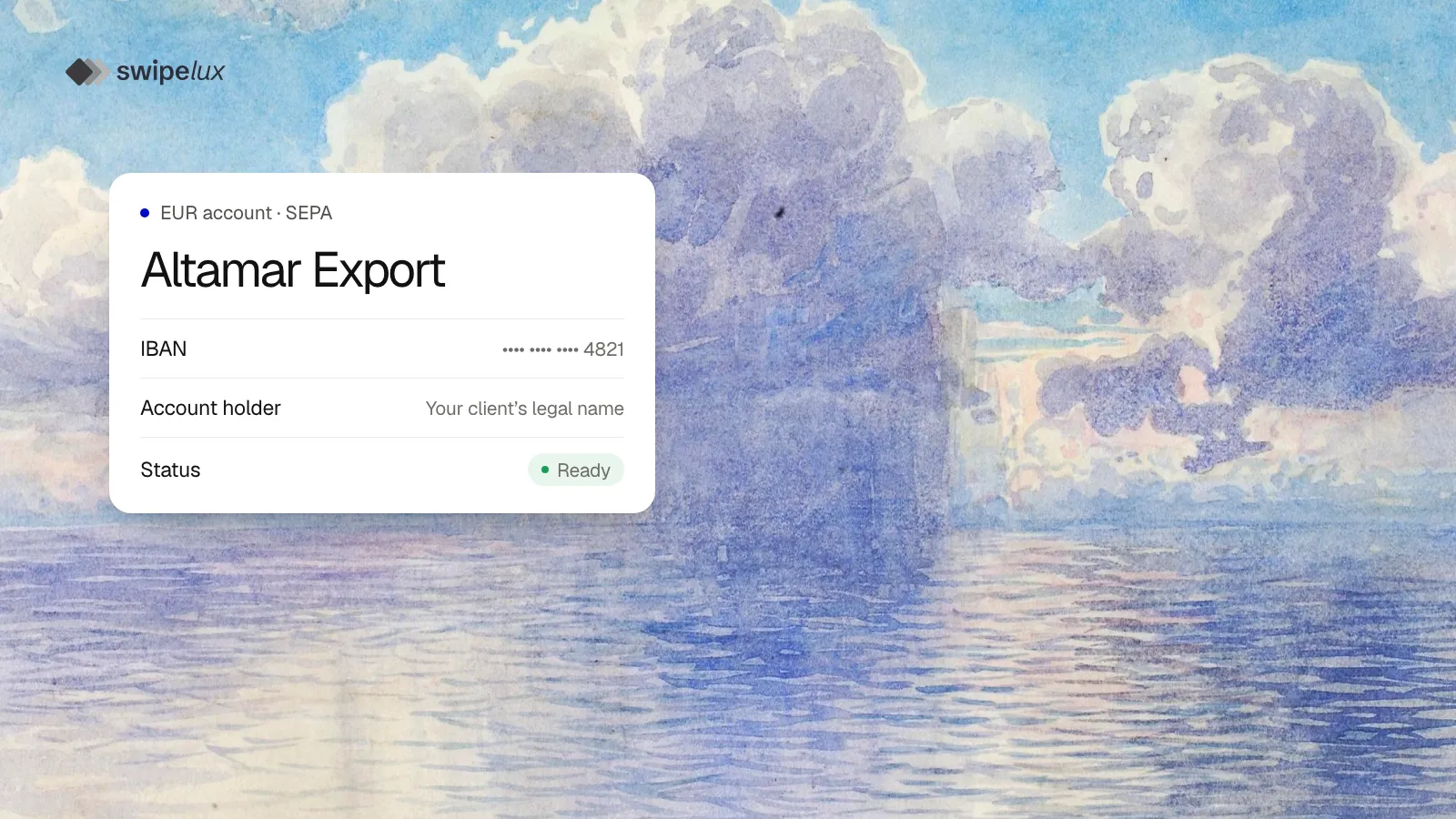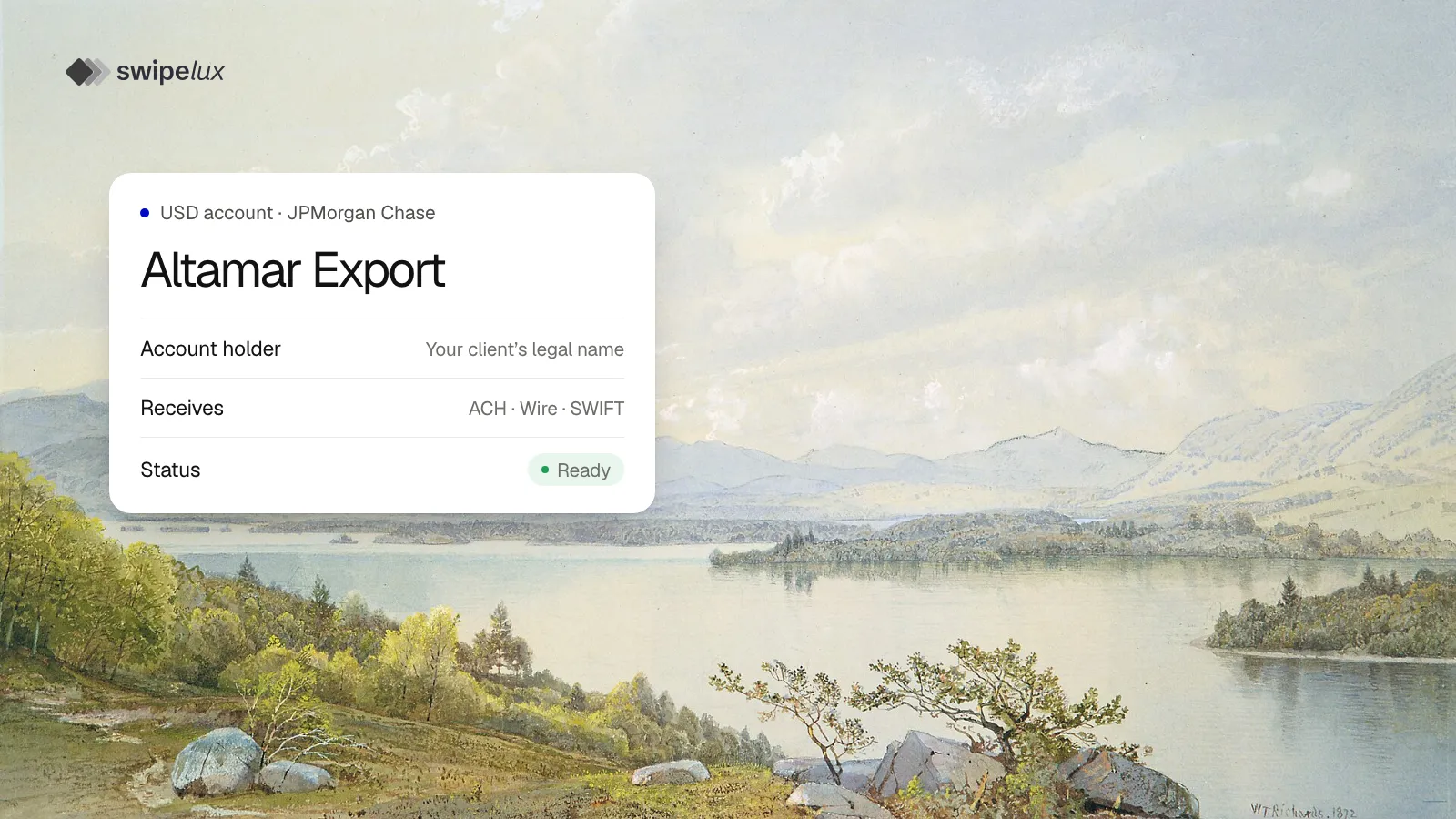
A named account gives your customer bank details in their own legal name, so payers see the customer as the account holder. A pooled FBO account is one account a provider holds for many customers. A virtual account number is a routing address in front of either. Users paid by third parties need named details; one-off transfers can stay pooled. In the Swipelux API you request ach_named instead of ach_pooled and read the name payers see in accountHolderName.
What is the difference between a named account, a pooled FBO account and a virtual account?
A named account and a pooled FBO account differ in whose name payers see: the customer's or the provider's. A virtual account number is not a third kind of account. It sits in front of either, and it carries whatever account holder name its issuer assigns: the customer's on a named virtual account, the provider's otherwise.
| What matters | Named account | Pooled (FBO) account | Virtual account number |
|---|---|---|---|
| Whose name the sender sees | Your customer's legal name | The provider's name, often with "FBO" | The name its issuer puts on it |
| Who holds the account at the bank | The customer, or the provider with details in the customer's name | The provider, as custodian | Whoever holds the account behind it |
| What your customer holds | A bank deposit, or a ledger balance | A share of the pool | Nothing: it holds no balance |
| Reconciliation | By account number; some banks add a reference | By a reference the payer types | By the number |
| What payers accept | Payers that need the payee's own name | Users funding their own balance | Depends on the name on it |
| When to choose it | Third parties pay your users repeatedly | One-off transfers and top-ups | You need one number per customer |
Named accounts come in two forms. Some providers open an account titled to the customer on the bank's books. Others issue virtual account details with the customer's legal name as account holder: a named virtual account. Swipelux issues the second kind, and each deposit settles into the customer's USDC or USDT wallet. With any provider, ask for sample payment details and read the account holder line.
What is an FBO account in banking?
FBO means "for the benefit of". An FBO account is a bank account that one company holds for other people. The company on the account controls it. Who owns the money in an FBO account depends on that company's terms: it belongs to the customers only when the company holds it as their agent or custodian.
Usually it is one account at a partner bank for all of a fintech's users, split per customer in a ledger outside the bank: an omnibus account.
What is a virtual account number?
A virtual account number is an account number that receives payments but holds no balance of its own. The bank or provider maps the number to a real account and to one customer in a ledger. It routes and reconciles payments and does not say who owns the money.
Behind a named virtual account the money usually still sits in a pooled account: the name changes what the payer sees, not where the funds are held.
Whose name does the sender see, and does the bank check it?
US rails have no name lookup: the sender and the sender's bank see only the name the sender types from the payment details, which is the end customer's on a named account and the provider's on a pooled one. The partner bank is only the receiving bank. Neither the ACH nor the wire rules make that bank compare the name: Nacha Rule 3.1.2 lets it post an ACH entry by account number alone, and UCC 4A-207(b), part of the Fedwire rules through Regulation J, says the same for wires.
- ACH. The Nacha bulletin of July 22, 2024 that restates Rule 3.1.2 also warns that a credit whose name does not match the account may indicate an account receiving illicit funds.
- Wire. Section 4A-207(b) says the beneficiary's bank "need not determine whether the name and number refer to the same person". It may rely on the number unless it knows they differ.
- Before sending. A name check is a fraud control, not a rule. The Federal Reserve offers banks Payee Name Verification, which checks a payee's name against the routing and account number before a payment is issued, starting from 12 months of transaction data.
A payment to a pooled account usually arrives, but a check of your user's name against provider-named details comes back as a mismatch. In Swipelux sales calls from May to November 2026, fintech companies described three problems with such details: transfers that show a processor's name, payments rejected over a name mismatch, and chasing every payer to type a reference. About one in five opened by asking for a USD account in the client's own name, more than for any other request.
Are FBO accounts FDIC insured?
FBO accounts are FDIC insured for each customer only through pass-through insurance, with three requirements: customers own the funds, the bank's records show the account is held for others, and records identify each owner's share. If the provider's terms make customers its creditors, the FDIC treats the deposit as the provider's. After Synapse's bankruptcy the FDIC proposed daily reconciliation of custodial accounts (89 FR 80135, October 2, 2024), a rule still not final on November 20, 2026.
If any requirement fails, the FDIC insures the deposit as the named account owner's, typically the third party's. Pass-through insurance is not a separate ownership category: a customer's share counts toward the same $250,000 as their other deposits in that category at that bank.
Deposit insurance pays only when an insured bank fails. Synapse Financial Technologies was a technology company, not a bank: after its bankruptcy, banks struggled to reconcile its records, and consumers could not reach funds held at insured banks for months. That is the risk in a pooled structure, and usually behind a named virtual account too: each customer's claim depends on a ledger kept outside the bank.
The FDIC announced the proposal, which covers custodial deposit accounts with transactional features, on September 17, 2024, and comments closed on January 16, 2025. The federal regulatory agenda still lists the rule as a long-term action, with the final rule date "to be determined". A separate FDIC proposal of November 17, 2026 on custodial deposits concerns an exception in the brokered-deposit rules, not recordkeeping.
When is a pooled account the right choice?
A pooled account is the right choice when the payer is the customer, or when a payment happens once and carries a reference. Either way, nobody on the paying side has to recognise the account name.
Swipelux's docs advise starting with pooled and using named only when a customer needs reusable details. On Swipelux, pooled has two limits: a pay-in quote can enforce a minimum amount, for example 20.00 USD for pooled wire, and pooled SWIFT only sends payouts, so receiving by SWIFT takes swift_named.
Can a neobank's users outside the US get USD accounts in their own name?
Yes: users who live outside the US get USD account details in their own legal name when a partner bank accepts them. Swipelux issues them for ACH, wire and SWIFT at partner banks JPMorgan Chase, Citi, CFSB, Lead Bank, Portage Bank or Zenus Bank; the API lists the banks open to each client in institutions, and you pick among those. Each deposit is converted and credited to that client's USDC or USDT wallet, the balance the client holds.
For a freelancer outside the US, Citi and CFSB are out: Citi takes business customers only, and CFSB's named accounts are not offered to clients outside the US. For a business registered outside the US, named Citi is open and named CFSB is not. Lead Bank accepts clients by legal form and country, and JPMorgan Chase's named accounts for individuals require the person's occupation. A bank that does not accept a client appears in unavailableInstitutions with a reason; the current codes are jurisdiction_unsupported, legal_form_unsupported and customer_type_unsupported. Look up a country on the coverage page. To check your users' countries and payers against the banks before you build, talk to sales.
How to issue a named account through the API
Four steps issue ACH details to a customer. Every request carries your X-API-Key, and every POST shown here an Idempotency-Key: one per operation, sent again unchanged when you retry it. The Issue a bank account guide has every field.
1. Create the customer
POST /v3/customers
{
  "type": "business",
  "externalId": "company_456",
  "business": { "legalName": "Acme Payments SAS" }
}
For a freelancer, send "type": "individual". For an individual only type is required; individual holds the profile fields you know, such as firstName, lastName and residenceCountry. A business also needs business.legalName.
2. Request the named capability
GET /v3/customers/{customerId}/capabilities/supported returns the capabilities and banks open to this customer. Leave institutions out of the request below and Swipelux picks the customer's default bank: Lead Bank when it can onboard the customer, JPMorgan Chase otherwise. Send a bank's ID to pin it. Sandbox serves ACH, wire and SWIFT at jpmorgan only.
POST /v3/customers/{customerId}/capabilities/ach_named
{ "institutions": ["jpmorgan"] }
3. Complete the customer's tasks
The capability returns openTaskIds: what this customer still has to pass. Tasks are hosted actions, document uploads and answers sent through the API, and KYB requirements and documents lists what a business sends.
4. Create the account and read its details
When the capability's status is ready, create a wallet for the customer, then the bank account. Deposits settle into that wallet in its own currency, or in USDC or USDT if you set settlement.currency.
POST /v3/customers/{customerId}/accounts
{
  "origin": "issued",
  "type": "wallet",
  "currency": "USDC",
  "network": "base"
}
Use the wallet's id as settlement.accountId. institution selects exactly that bank:
POST /v3/customers/{customerId}/accounts
{
  "origin": "issued",
  "type": "bank",
  "method": "ach",
  "country": "US",
  "currency": "USD",
  "institution": "jpmorgan",
  "settlement": { "accountId": "acc_..." },
  "label": "USD account"
}
With institution and allowPending: true you can save this request while the bank still reviews the client. Read the account until details is present; it is null while provisioning. The response below is abbreviated.
GET /v3/customers/{customerId}/accounts/{accountId}
{
  "data": {
    "type": "bank",
    "origin": "issued",
    "status": "ready",
    "details": {
      "routingNumber": "...",
      "accountNumber": "...",
      "accountType": "...",
      "bankName": "...",
      "accountHolderName": "Acme Payments SAS"
    }
  }
}
accountHolderName is the line your customer's payers read. When details.achRoutingNumber or details.wireRoutingNumber is present, show it instead of the legacy routingNumber. Wire and SWIFT are separate capabilities, wire_named and swift_named. A SWIFT account is a separate account with its own details, including the bank's swiftCode and a beneficiary address in accountHolderAddress that senders must copy exactly. ACH vs wire vs RTP vs SWIFT compares the rails by speed, limits and reversibility.
A single payment of a known amount needs no bank account, only the customer's wallet and a ready pay-in capability: a quote, a transfer and the transfer's instructions (Receive funds).
Questions people ask
Can a named account receive payments from third parties?
Yes. Swipelux's API docs describe named details as reusable and shareable with any payer, and deposits to them are matched by account number, plus the reference when details.referenceRequired is true. First-party vs third-party payments explains how banks treat each kind of payer.
Do banks in Europe check the payee's name?
In the euro area, yes. Since October 9, 2025, Article 5c of Regulation (EU) No 260/2012, added by Regulation (EU) 2024/886, makes the payer's bank match the payee's name against the IBAN (Verification of Payee) before the payer authorises a euro credit transfer, and warn the payer when the two do not match. A payer who types your user's name for an IBAN registered to a provider gets that warning.
What does a customer have to pass before a named account is issued?
Verification by Swipelux and by the bank. An individual passes KYC in a hosted session: an ID document, a selfie and, where the task asks for it, a proof of address. A business passes KYB on the legal entity, its owners and its control persons, and names a beneficial owner with declared ownership or at least 25%. Swipelux then sets that customer's transaction limits by customer type, verification level and risk review.
How long does verification take before a named account is issued?
For an individual, Swipelux's policy estimates 1 to 3 minutes for automated checks, 1 to 24 hours for standard review and 1 to 3 business days for enhanced review. For a business it estimates 1 to 2 business days for initial review, 2 to 5 for standard KYB and 5 to 10 for enhanced due diligence when it is triggered. They are estimates, not guarantees.
What happens if a bank rejects one of our users?
You request the capability again with another bank's ID. Each client has one application per bank, and a rejection at one bank does not affect the application at another. One approved application is enough to make a named capability ready, and one approval can cover both ACH and wire.
How do we move users we have already verified onto named accounts?
Send Swipelux what you already hold. Create each user as a customer with your own ID in externalId, add the profile fields you have and upload their documents. On intake tasks that take answers through the API, the requirements those cover move to review, and the user is asked only for what is missing. An individual's hosted identity session still runs, with one exception: if you verified the user in your own account at the verification provider Swipelux uses, you import that verification with a share token (POST /v3/customers/{customerId}/tasks/{taskId}/verification-sessions/{verificationSessionId}/share-token), and the user is sent to the hosted session only for steps that are missing.
Does the payer have to add a reference?
With pooled details, yes: the reference routes the money to your customer. With an account issued by Swipelux, read details.referenceRequired: when it is true, a deposit without the exact details.reference can stay unmatched at the receiving bank.
How does a client get dollars out of a named account?
By a payout from the wallet: the client's USDC or USDT balance is the source, and the destination is a bank account the client owns or a third-party recipient's. A client with a named account can send the payout under its own name, so the recipient's bank sees the client as the sender. Every payout starts from a quote, and Send funds has the requests.
What does a named account cost?
On Swipelux, a transaction fee of 0.01–0.5% per transfer, set by corridor and volume, with bank charges at cost and FX in the quote. Pay as you go has no platform fee and no volume commitment. KYC and KYB are priced per check. The pricing page works through one transfer with every number.
Start now
- Sign up for Swipelux; Sandbox is ready right away.
- Create a customer and request a named capability such as
ach_named. - Create the wallet and the bank account, then show your client the details in their name.
Building with Claude Code or Codex? The Swipelux wizard has your coding agent add named bank accounts to your app and test them in Sandbox.