A virtual IBAN (vIBAN) is an IBAN-format identifier that routes payments into a master account instead of holding a balance. Platforms give each customer one for SEPA pay-ins in EUR. A named IBAN is registered in your customer's legal name, a pooled IBAN in the provider's. In 2024 the European Banking Authority called it unclear which provider answers a payer's name check when the vIBAN's user does not hold the master account.
How does a virtual IBAN (vIBAN) work?
Every payment sent to a virtual IBAN is credited to its master account, a payment account with a different IBAN, the European Banking Authority's 2024 report on virtual IBANs explains (paragraphs 11 and 13). The vIBAN has the same format and functionality as a regular IBAN, so the payer's bank sees neither that the number is virtual nor which master account sits behind it.
Regulation (EU) 2024/1624, which applies from 10 July 2027, puts the term into EU law. Its Article 22(3) makes the issuer verify who uses each vIBAN, and requires that the institution servicing the master account can obtain that identity within five working days.
Virtual IBAN vs named IBAN vs pooled IBAN
Virtual describes how a payment is routed. Named and pooled describe whose name is registered for the IBAN, and whether customers share it. Providers offer three setups:
| What matters | Virtual IBAN in the provider's name | Named IBAN | Pooled IBAN |
|---|---|---|---|
| IBAN per customer | One each | One each | One shared by all customers |
| Name registered for the IBAN | The provider's | Your customer's legal name | The provider's |
| Name Verification of Payee checks | The provider's; your customer's only if confirmed as one of several payees | Your customer's, if the issuer registered it and answers the check | As in the first column |
| Master account held by | The provider | The end user or the provider, by setup | The provider |
| Reconciliation | By IBAN | By IBAN | By payment reference; without it the deposit stays unmatched |
| Choose it when | Customers top up their own balance with the provider | Third parties pay your customers, or payers' banks check the name | Transfers are one-off |
Providers call all three virtual IBANs, so ask which one you get per currency. For USD, see named vs pooled FBO accounts.
Whose name does the payer see, and does it pass Verification of Payee?
The payer sees their own bank's verdict on the name they typed, and the registered name itself only on a close match. Verification of Payee compares the typed name with the name registered for the IBAN at the payee's payment service provider, before a euro credit transfer is authorised. The result depends on which name the issuing provider registered, and on whether that provider answers.
The check comes from Article 5c of the SEPA Regulation, added by the Instant Payments Regulation (EU) 2024/886. Payment service providers in euro-area member states had to offer it by 9 October 2025. Those in other EU member states have until 9 July 2027, so a check on their IBANs can come back unanswered until then. The European Payments Council's Verification Of Payee scheme returns one of four answers: match, close match, no match or check not possible.
For a virtual IBAN the law does not say who answers. The European Commission's Q&A on the regulation lets a payment institution and the bank that holds its pooled account agree which of them replies. When one account is held for several payees, Article 5c requires its provider to confirm, when the payer's bank asks, whether the named payee is among them. The EBA report (paragraphs 80 and 81) calls it unclear which provider must answer, and with what, when the vIBAN's end user does not hold the master account. Ask a provider for a live check on one of its IBANs: which answer came back, and for which name.
Does a virtual IBAN work with SEPA Instant?
Yes, when the provider that issues the IBAN is reachable for SEPA Instant. SEPA Credit Transfer works in 41 SEPA countries, and SEPA Instant, in the European Payments Council's words, aims to progressively reach all 41.
A SEPA Instant payment makes the funds available on the payee's account in less than ten seconds, every day of the year. The scheme sets no maximum amount under its 2025 rulebook, in effect since 5 October 2025, so the SEPA Instant limit you meet is the one your provider sets.
Under the Instant Payments Regulation, banks in the euro area had to receive instant euro payments by 9 January 2025 and send them by 9 October 2025. Payment institutions and electronic money institutions (EMIs) there have until 9 April 2027. Banks in other EU member states must receive by 9 January 2027 and send by 9 July 2027.
What is IBAN discrimination?
IBAN discrimination is when a payer or payee refuses a euro transfer or direct debit because the IBAN carries another country's code. Article 9 of the SEPA Regulation (EU) No 260/2012 forbids it for payment accounts located in the Union: a German employer or a French utility may not refuse an IBAN because it starts with LT. A UK or Swiss IBAN is outside the rule.
The practice still occurs, the EBA reports, and some companies take a vIBAN with a chosen country code to get around it. A vIBAN from a Lithuanian e-money institution receives SEPA Instant only when that institution is reachable for it, as the law requires of euro-area e-money institutions by 9 April 2027.
EUR accounts on Swipelux: euro details, USDC balance
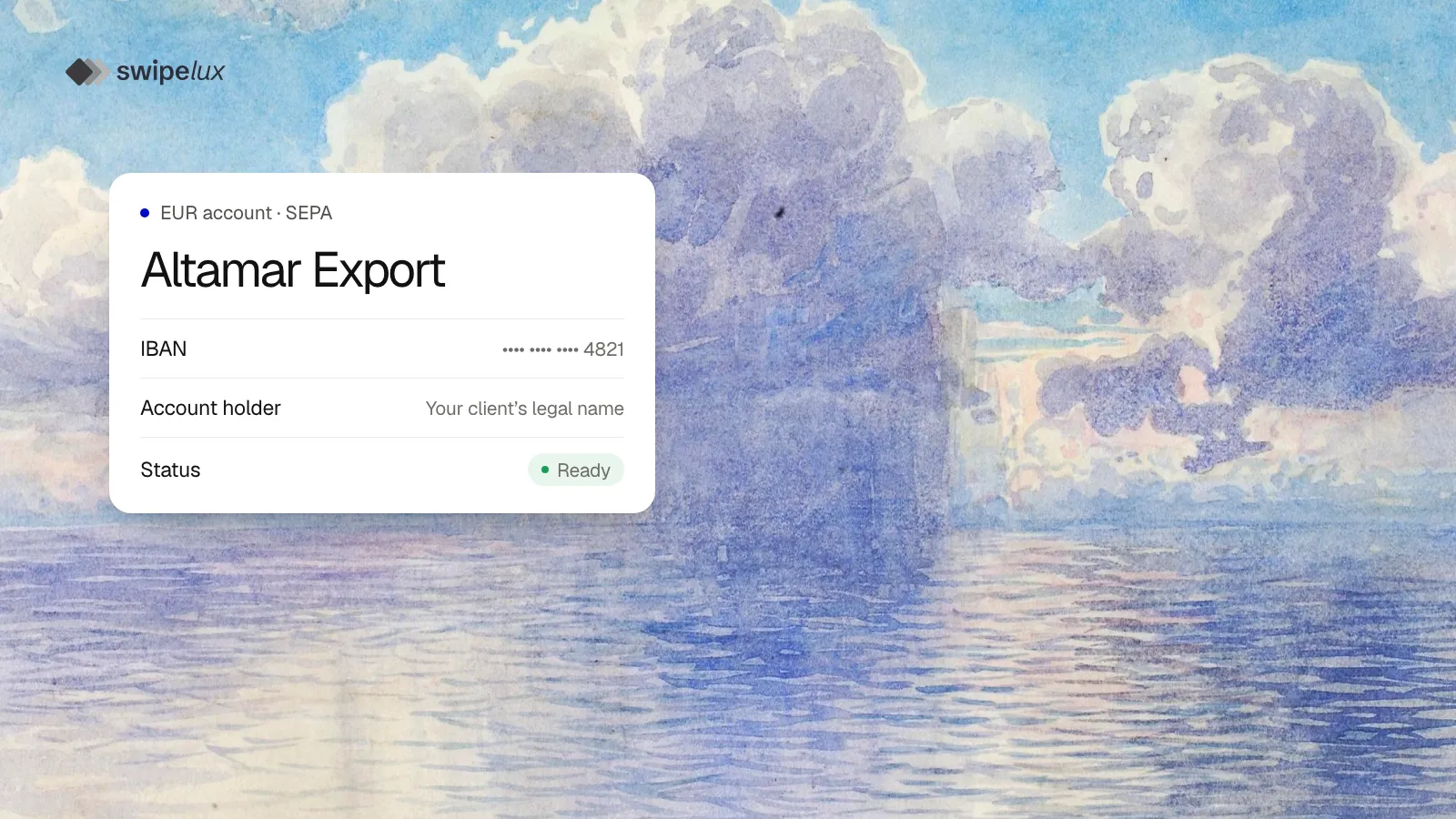
Swipelux offers EUR accounts alongside its USD accounts. A EUR account is a set of EUR bank details: each deposit is converted and credited to the client's USDC wallet, so the client's balance is in USDC, not in euros. The method is sepa, with two capabilities:
sepa_named: dedicated bank details for the customer, a virtual IBAN issued in the client's legal name and reusable for every deposit.sepa_pooled: a shared Swipelux bank account. Each pay-in uses a unique reference. Pick it for one-time transfers.
SEPA works in both directions, and a transfer typically arrives the same or next business day once sent. From the wallet you pay out in EUR by SEPA, in USD by ACH or wire, or on-chain, to the customer's own account or to a third-party recipient. Every payout starts from a quote.
How to issue a virtual IBAN through the API
On Swipelux that is five requests in four steps, then the first pay-in. Every request carries X-API-Key. Every POST carries an Idempotency-Key: one per operation, and the same one when you retry it. The Issue a bank account guide has every field.
1. Find the named SEPA capability
The supported list returns this entry (abbreviated):
GET /v3/customers/{customerId}/capabilities/supported
{
  "data": [
    {
      "id": "sepa_named",
      "method": "sepa",
      "accountType": "named",
      "directions": ["payin", "payout"],
      "availability": "available",
      "eligibility": { "eligible": true, "reason": null },
      "institutions": [
        { "id": "...", "name": "...", "bic": "...", "isDefault": true }
      ]
    }
  ]
}
institutions names the institution behind the capability, with its BIC. availability is available, beta or disabled: continue on the first two when eligibility.eligible is true. Request the capability with POST /v3/customers/{customerId}/capabilities/sepa_named, then complete the KYC or KYB tasks it opens (Capabilities and tasks).
2. Create the settlement wallet
POST /v3/customers/{customerId}/accounts
{
  "origin": "issued",
  "type": "wallet",
  "currency": "USDC",
  "network": "base",
  "label": "Settlement wallet"
}
Wallets hold USDC or USDT on Base, Ethereum, Polygon and Solana. Use USDC here: USDT delivery requires a USD account.
3. Issue the EUR account
POST /v3/customers/{customerId}/accounts
{
  "origin": "issued",
  "type": "bank",
  "method": "sepa",
  "currency": "EUR",
  "settlement": { "accountId": "acc_..." }
}
Send this once the sepa_named capability reads ready. settlement.accountId is the wallet from step 2. The account starts as provisioning with details: null. Read it again after each account.status_changed webhook.
4. Read the IBAN
GET /v3/customers/{customerId}/accounts/{accountId}
{
  "data": {
    "id": "acc_...",
    "type": "bank",
    "method": "sepa",
    "capabilityId": "sepa_named",
    "accountType": "named",
    "origin": "issued",
    "status": "ready",
    "openTaskIds": [],
    "currency": "EUR",
    "details": {
      "iban": "...",
      "bic": "...",
      "bankName": "...",
      "accountHolderName": "..."
    },
    "settlement": { "accountId": "acc_..." }
  }
}
accountHolderName is the name to give payers. When referenceRequired is true, show reference next to the IBAN.
5. A SEPA pay-in arrives
When a payer sends a SEPA transfer to the IBAN, the deposit is matched to the account, converted and credited to the settlement wallet. The deposit appears in GET /v3/transfers with origin: "inbound_deposit", and sender.name carries the payer's name when available. A webhook follows every deposit and state change.
For a one-off amount, quote the pay-in instead:
POST /v3/quotes
{
  "customerId": "cus_...",
  "capabilityId": "sepa_pooled",
  "in": { "amount": "150.00", "currency": "EUR" },
  "destinationId": "acc_...",
  "out": { "currency": "USDC" }
}
Create the transfer with POST /v3/transfers, then read GET /v3/transfers/{transferId}/instructions for the IBAN, the BIC and the reference the payer must include. To land the money in USD, quote a payout from the wallet with out.currency set to USD (Send funds guide).
Virtual IBANs for remittance companies, exchanges and OTC desks
EUR accounts were the first request of about one company in seven on our sales calls with fintech companies between May and November 2026. Three situations bring them to us:
- The current provider has USD only, so customers in Europe have no local way to pay in.
- The euro account's IBAN is in the provider's name, so payers' banks flag it.
- A European partner stopped serving the flow, and euro collections stopped with it.
Remittance companies: a named IBAN lets a sender in Europe pay by SEPA into details that carry your customer's name. The USDC is then in the customer's wallet, ready for a quoted payout to a bank account. See Swipelux for remittance.
Exchanges and OTC desks: decide first who the payee is. If clients pay the desk, onboard the desk as the business customer and issue one IBAN in its legal name. If each client pays into their own IBAN, each client is a customer who passes KYC or KYB, and deposits are credited to that client's wallet; a rule (POST /v3/customers/{customerId}/rules) can forward them to another wallet on the same network. See Swipelux for corporate treasury.
What to check before choosing a virtual IBAN provider
Six questions for any virtual IBAN provider, each with the Swipelux answer:
- Whose name is on the IBAN? Your customer's legal name, returned as
details.accountHolderNameon the account. - Which institution is behind it? The API says before you issue:
institutionsin the supported-capability response lists the banks open to that customer, and the account returnsdetails.bankNameanddetails.bic. - Dedicated or pooled? Both exist:
sepa_namedissues an IBAN in the customer's legal name,sepa_pooledgives shared details, andaccountTypeon the account says which. - Can you pay out as well as collect? Yes. SEPA covers collection and payouts, and each capability's
directionslists which ofpayinandpayoutit allows. - Euros or a stablecoin, and at what rate? USDC. A deposit to the named IBAN is not quoted in advance: it is priced when it arrives, and its transfer then shows
amounts.inandamounts.out. A quoted pay-in or payout returnsrateandfeesbefore you execute. - What limits apply? Limits are set per customer, by customer type, verification level and risk review. Ask for yours before you build.
Swipelux and Bridge compared shows what Bridge's docs say about the name and the bank on its EUR accounts.
Questions people ask
Which country code will a vIBAN have?
The code of the country where the institution servicing the account resides, under the ISO IBAN standard. A vIBAN can still carry a different code from its master account: the EBA describes vIBANs with a host country's code whose master account stays in the home country. National supervisors disagree on whether that needs a branch there, the EBA notes.
Can third parties pay into a named IBAN?
Yes on Swipelux: named details can be shared with any payer, so the IBAN can go on an invoice. Some vIBANs only let a customer top up their own e-money account, the EBA notes.
Can a non-EU company get a EUR account for its customers?
The API returns the answer for each customer. GET /v3/customers/{customerId}/capabilities/supported gives eligibility.eligible for sepa_named, and unavailableInstitutions gives a bank's reason for refusing: jurisdiction_unsupported, legal_form_unsupported or customer_type_unsupported. The coverage page lists the 31 European countries Swipelux reaches by SEPA. The EBA adds a caution (paragraph 83): a non-EU financial institution that offers EU-issued vIBANs to customers in the EU risks providing payment services there without authorisation.
Can a crypto exchange give each customer an IBAN?
Through the API, yes: each of the exchange's customers passes KYC or KYB, gets a sepa_named EUR IBAN and has every SEPA deposit converted and credited to their own USDC wallet. The exchange's own business is reviewed first. The Supported Verticals page puts "Trading/CFD" businesses under enhanced due diligence and requires "a financial investment license". It does not name crypto exchanges, so confirm your case before you build.
Can my customers hold a balance in euros?
No. On Swipelux a EUR account is a set of EUR bank details in the customer's legal name. Each SEPA deposit is converted and credited to the customer's wallet in USDC. Euros leave again by a quoted SEPA payout from the wallet.
How long does it take to open a EUR account for a business?
Swipelux's policy estimates are 1 to 2 business days for the initial review, 2 to 5 for standard KYB and 5 to 10 with enhanced due diligence. They are estimates, not guarantees. The capability's accountProvisioning field reports when the account is issued. Our KYB documents guide lists the documents.
What does a virtual IBAN cost?
On Swipelux, KYC per person and KYB per business are priced per check, and the transaction fee is 0.01–0.5% per transfer, set by corridor and volume, with bank charges at cost and the FX rate and spread shown in the quote. Pay as you go has no platform fee and no minimums. You add your own fee per client.
Are virtual IBANs safe?
Not by default. The EBA's 2024 report names 10 risks, among them money laundering when providers do not know the end user. A 2026 report by France's ACPR and Tracfin found that the few institutions offering multi-country IBANs took some 20% of the value of transfers recalled for fraud in France in 2022. On Swipelux, KYC or KYB comes before an account is enabled, and transfers are screened for sanctions.
Start now
- Sign up for Swipelux; Sandbox is ready right away.
- Create a customer and a wallet, and request the
sepa_namedcapability. - Issue the EUR account and read the IBAN, or talk to sales about your euro flow.